






Pain is not always what we commonly think it is. Some pains are physical, while others are those originating in the mind. But regardless of the type, the commander of the pain sensation is the mind only. In other words, without mind’s sanction no pain can be felt. This can be demonstrated by various examples.
If someone is hungry but absorbed in a more engaging activity, the feeling of hunger becomes less noticeable. Similarly, a person suffering from a toothache may hardly register the pain if suddenly confronted with shocking news. We often fail to notice someone walking right in front of us, or ask a speaker to repeat themselves even when our ears are wide open. An athlete may play through an injury and not feel pain until after the game is over and the mind get free to focus on the injury. This happens because the mind governs the senses.
While Vedic science has very clearly outlined the hierarchy of the physical senses and the mind, which is a subtle sense, modern science also has begun exploring similar ideas. Phenomena such as phantom limb pain, the placebo effect, and distraction techniques all suggest that there is more to our experience of pain than what is felt by the physical senses alone.
For the uninitiated, Phantom limb pain refers to the pain felt in an amputated limb, which no more exists. Placebo effect is experiencing pain relief after receiving a fake treatment, such as a sugar pill, that they believe is a real drug. Distraction techniques help significantly reduce pain by shifting a patient’s focus. What they call Cognitive behavioral therapy (CBT) is a psychotherapy that helps patients identify and change unhelpful or distorted thought patterns and behaviours that negatively influence their emotions and pain perception.
These common experiences clearly establish the principle: the mind controls the physical senses. In other words, if the mind is trained to not feel the pain, no pain will be felt. The big question is, how to train the mind? To answer that, we first need to understand a bit of Vedic science.
Bhagavad Gita (3.42) says: The working senses are superior to dull matter; mind is higher than the senses; intelligence is still higher than the mind; and the soul is even higher than the intelligence.
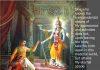
So it is clear that the intelligence commands the mind. If we can get our intelligence to direct the mind, the problem of pain is over. Yet, the difficulty lies in the nature of the mind itself. This is frankly admitted by Arjuna in Bhagavad Gita (6.34), where he says to Lord Krishna: For the mind is restless, turbulent, obstinate, and very strong, O Krishna, and to subdue it is, it seems to me, more difficult than controlling the wind.
In the very next verse (BG 6.35) Lord Krishna says: O mighty-armed son of Kuntī, it is undoubtedly very difficult to curb the restless mind, but it is possible by suitable practice and by detachment.
But again, what exactly is that practice, and detachment from what? There are two types of practices and corresponding perfections. 1) Devotional service, or Bhakti-yoga, and 2) Eightfold yoga system, or Ashtanga-yoga. However, what bhakti-yoga offers is unparalleled and most suitable especially for the people of this age, Kaliyuga.
As Srila Prabhupada confirms this in his purport, suitable practice refers to nine types of devotional service, or navadha bhakti:
In the present age no one can observe the strict rules and regulations of placing oneself in a sacred place, focusing the mind on the Supersoul, restraining the senses and mind, observing celibacy, remaining alone, etc. By the practice of Krishna consciousness, however, one engages in nine types of devotional service to the Lord. The first and foremost of such devotional engagements is hearing about Krishna. This is a very powerful transcendental method for purging the mind of all misgivings.
The beauty of this process is, the more one hears about Krishna, the more one becomes enlightened and detached from everything that draws the mind away from Him. This is because the name of Krishna is non-different from Krishna Himself. Lord Krishna declares Himself in Bhagavad Gita (7.7), mattah parataram na-anyat kinchid asti – “there is no Truth superior to Me”. Therefore, being engaged in His thoughts is the highest and most powerful activity.
It is said that Krishna is the light and Maya is darkness, where there is Krishna, there is no darkness. In other words, by purifying our intelligence by hearing about Krishna and training the mind to be attached to Him, we naturally detach it from mundane activities, the activities not devoted to the Lord. This is the easiest way to cultivate vairagya, which means detachment from matter.
On the other hand, the practice of ashtanga yoga can also control the mind and purify the intelligence but it is more austere and boring, and on top of all, it is not recommended for this age. The recommended process in Kaliyuga is hearing the holy names of the Lord. This is confirmed in Srimad Bhagavatam (12.3.52)
kṛte yad dhyāyato viṣṇuṁ tretāyāṁ yajato makhaiḥ
dvāpare paricaryāyāṁ kalau tad dhari-kīrtanāt
“Whatever result was obtained in Satya-yuga by meditating on Viṣṇu, in Tretā-yuga by performing sacrifices, and in Dvāpara-yuga by serving the Lord’s lotus feet can be obtained in Kali-yuga simply by chanting the Hare Krishna mahā-mantra.”
What truly matters is peace of mind, as without it there is no possibility of experiencing happiness. As living beings are constitutionally spiritual, the inclination to seek happiness is innate to them. One who takes up the Ashtanga-yoga system to control the mind may attain peace of mind, but because the soul is intrinsically blissful, it requires great effort to remain steady on that platform. Moreover, without the shelter of the Lord’s ultimate personal feature, there is always the risk of falling back to the mundane state. For these and various other reasons, the path of devotional service is strongly recommended.
“Impersonal spiritual detachment is more difficult than attaching the mind to the activities of Krishna. This is practical because by hearing about Krishna one becomes automatically attached to the Supreme Spirit. This attachment is called pareśānubhava, spiritual satisfaction. It is just like the feeling of satisfaction a hungry man has for every morsel of food he eats. The more one eats while hungry, the more one feels satisfaction and strength. Similarly, by discharge of devotional service one feels transcendental satisfaction as the mind becomes detached from material objectives.” (SP purport BG 6.35)

Returning to the point, when we purify our intelligence through attachment to devotional service to Lord Krishna, it gains the strength to properly guide the mind, which otherwise has a tendency to rebel. When the mind is thus governed by intelligence, it can, in turn, control the physical senses and prevent them from registering pain.
This is how yogis are able to tolerate any amount of pain. While great sages of the past, such as Dadhichi Muni and others, regulated their senses and the corresponding experiences of pleasure and pain through the Ashtanga-yoga process, illustrious devotees like Bhakta Prahlad and the Pandavas overcame the pain inflicted upon them by taking full shelter of the Supreme Lord.
But there is more to it. To rid oneself of pain, or to not feel it, is indeed a great achievement, yet that is not the ultimate solution. We must advance to a stage where pain does not exist at all. Running an air-conditioner to counter the heat is one thing, but living in a naturally cool and pleasant climate is far superior. The realm where pain has no existence at all is called Vaikuṇṭha. Vaikuṇṭha is not some fanciful imagination, as thought and taught by the less intelligent; it is a tangible, experienceable reality.
Let us not forget that the Bhagavad Gītā describes the material world as dukhalayam, a place of misery and pain. As long as we remain entrapped here, we are bound to encounter suffering in different forms, even if we learn not to be affected by it. To transcend pain forever, we must give up our false ego, or false identification with matter, and enter Vaikuṇṭha, taking shelter at the lotus feet of the Lord, also known as param-padam, the supreme destination. Once there, no worldly power can touch our innate ability to remain perpetually free from pain and to live in eternal bliss.
DOWNLOAD MAYAPUR VOICE APP