







When Lata Mangeshkar departed from this world, I thought of writing a tribute to her, but time slipped by too quickly, and soon the internet was flooded with tributes to that out-of-this-world singer. I felt I had missed the moment. But now, when another legend, Asha Bhosle, has also taken her final leave, I do not wish to miss writing at least a few lines about the remarkable singer duo of the golden age of Hindi cinema. Better late than never.
My appreciation for some of the Hindi cinema singers goes back a generation, when songs were not only written, woven into melody, and sung; they were felt. They are still felt, and felt across generations. This is where the older songs make a definitive difference and establish their undeniable and lasting superiority over much of post-1970 songs.
The story of the two legendary sisters, Lata Mangeshkar and Asha Bhosle, is nothing less than the story of the golden age of Hindi cinema. Unlike today, there was a time when music carried depth, poetry, and emotion in a way that touched the heart, and these two sisters stood at the very heart of that era.
Frankly speaking, to connect Lata Mangeshkar, Asha Bhosle, and for that matter singers like Mohammed Rafi, Mukesh, Kishore Kumar, and a few other legends of that era with what is called “Bollywood” today is to reduce a legacy that belongs to the very soul of the golden age of Hindi cinema.
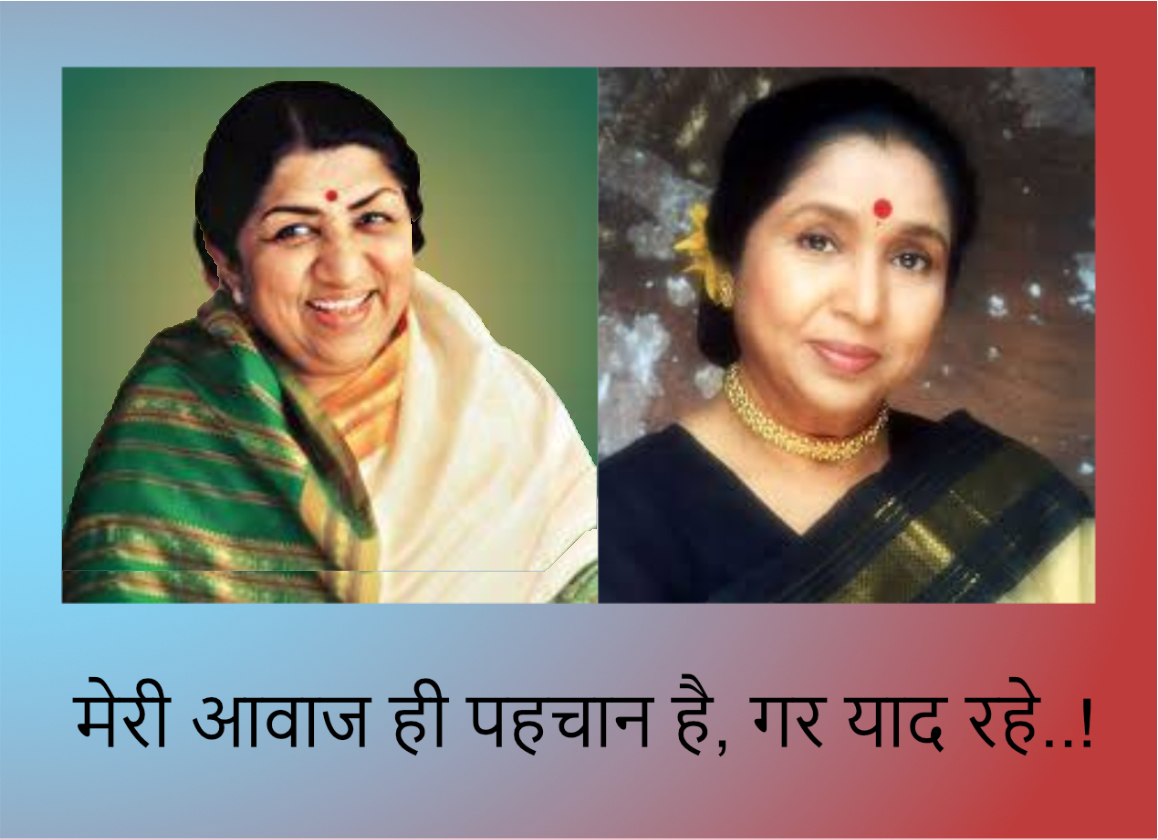
While Lata Mangeshkar’s voice and skills remain a phenomenon beyond comparison, Asha Bhosle’s voice and style of singing carry a distinctive flavor that remains uniquely her own.
Over a career that spanned more than seven decades, Lata Mangeshkar recorded tens of thousands of songs, generally estimated around 30,000, across more than 30 languages, although some estimates place the number at over 40,000. But numbers, impressive as they are, barely scratch the surface. There was a certain purity in her voice, a kind of untouched clarity that seemed to descend from a higher plane. It is said in the Vedic scriptures that in the Gandharva-loka, there are beings who are exceptionally gifted singers and musicians. I would not be surprised if Lata Mangeshkar was one such soul who, for some reason, came to this planet and offered timeless melodies to the world.
Whether it was a devotional piece, a classical composition, a romantic duet, a song filled with sighs and sorrow, or even a simple melody, she brought a level of sincerity and emotional depth that is almost impossible to replicate today. It is not an exaggeration to say that personalities like Lata ji do not appear in every age. Some voices entertain, some impress, but a rare few become timeless, and Lata Mangeshkar belongs firmly in that rare category.
If Lata Mangeshkar was endowed with what she was, Asha Bhosle was blessed with a unique set of talents too. With over 12,000 songs to her credit, Asha ji demonstrated a versatility that few artists in any field can claim. She could move effortlessly from classical compositions to playful, modern styles, embracing change while maintaining her identity. There was a distinct character in her musical journey, a willingness to explore and adapt.
Behind the glory and success, both sisters, like all others in this world, also passed through their share of personal struggles. Lata Mangeshkar, from a very young age, took upon herself the responsibility of supporting her family and, while choosing to remain unmarried, dedicated her life almost entirely to her art. In recognition of her unparalleled contribution, she was awarded the Bharat Ratna, India’s highest civilian honor, in 2001. Asha Bhosle, on the other hand, faced difficulties in her early marriage, but showed remarkable resilience in moving forward. Her second marriage to R. D. Burman brought stability and creative fulfillment, as they shared a strong personal bond until his departure.
On a personal level, although I relish many of Asha Bhosle’s songs, solo or duets, Lata Mangeshkar remains my favorite female singer, and I do not see anyone else who can replace that position. I thought of mentioning a few of her songs, but it would be an injustice to her many other renderings, for the number of soul-stirring songs she has sung is simply too many to mention here.
Let me also mention that Usha Mangeshkar, another sister, though less prominent in public recognition, has added her own quiet strength to this musical legacy. Her work in devotional and regional music, along with select film songs, carries a sincerity that deserves respect. Not every contribution needs to be large to be meaningful. In an age filled with giants, her role has been more subtle, but it is genuine and culturally valuable.
The departure of celebrated personalities often leaves the world in shock, followed by an outpouring of admiration for their qualities and accomplishments. But beyond all the praise lies a deeper message that is often missed. Life in this material world, no matter how glamorous it may appear, is temporary and fragile, much like a bubble that eventually bursts.
Despite their unique personalities and differing choices in life, both Lata Mangeshkar and Asha Bhosle left behind a common and powerful message; a message not favored by all, yet one that remains an inevitable reality. Both of them left behind assets worth hundreds of crores. These are significant material achievements by any standard. Yet, as with every human being who comes to this world, none of it accompanies the soul at the time of departure.
What such moments truly call for is introspection. Human life is not meant to be spent merely in pursuit of temporary pleasures or achievements. Death does not wait for old age, nor does it give prior notice. Therefore, real wisdom lies in using this valuable human life to understand and practice genuine spirituality. To remain absorbed in material pursuits, without striving for higher realization, is to miss the true purpose of life.
Both the sisters’ names will be remembered, their songs will live on, and their dedication will be remembered, but alongside that appreciation, their departures should also remind us of a higher reality, the futile nature of material accomplishment and the permanent nature of spiritual realm.
The founder-acharya of ISKCON, Srila A.C. Bhaktivedanta Swami Prabhupada, in a profound one-line message, said: “You cannot take anything with you. Everything will be left behind.” (August 22, 1973, London). The irony of life repeatedly reminds us that no amount of fame, wealth, or recognition can alter this fundamental reality.
Lord Krishna also says: “As a person puts on new garments, giving up old ones, the soul similarly accepts new material bodies, giving up the old and useless ones.” (Bhagavad Gita 2.22)
This wisdom, timeless in the true sense of the term, is the crux of of realizing we are not this body but the soul within it. Achievement is glorious, excellence is inspiring, and sincere contribution leaves a lasting impact, but none of these replace the ultimate purpose of human life. Wealth stays here. Fame fades with time. Even the body itself vanishes back into the five fundamental elements. What endures is one’s consciousness, one’s spiritual progress, and one’s relationship with the Absolute Truth.
Hare Krishna
DOWNLOAD MAYAPUR VOICE APP